Can Airboats Tip Over? Airboat Safety In Orlando Explained
Airboats look precarious, flat-bottomed sleds skimming across shallow water at speed. Here is what actually determines whether one tips, what Florida law requires of every boat, and what the state's real incident record shows.

Short answer
Yes, airboats can tip or flip, but it is rare on commercial tours. Florida logged 694 reportable boating accidents and 51 fatalities statewide in 2025 across all vessel types. Airboats stay upright through wide, flat hulls and low-mounted engines, and Orlando operators run inspected boats with captains who know their home waters.
Thousands of riders take the Boggy Creek one-hour ride every month with a 4.8 rating across 905 reviews. See today's times for the same tour this guide uses as its stability reference point.
Check Today's Times For The One-Hour Ride → Compare every tour
Can Airboats Tip Over?
Yes, an airboat can tip over, but a capsizing on a commercial Orlando tour is a rare event, not a normal risk of the activity. Florida's 2025 boating data counted 694 reportable accidents and 51 fatalities statewide across every vessel type, and the airboat incidents that made news in 2025-2026 happened on private or remote-water trips, none with the operators reviewed on this site.
The question deserves a straight answer rather than a shrug. An airboat is a flat-bottomed boat pushed by an aircraft-style engine and propeller mounted above the stern, and it is designed to cross water only a few inches deep, the kind of water where ordinary propeller boats cannot go at all. That design is exactly why airboats handle differently from any boat most visitors have ridden. It also explains both the boat's strengths and its genuine failure modes, which are worth understanding before you book anything.
A reasonable comparison: thousands of riders take the Boggy Creek one-hour airboat tour near Kissimmee every month, a ride that holds a 4.8 rating across 905 reviews on its live listing, and the reviews describe wildlife sightings and wind in the face, not close calls. The same pattern holds across the established Central Florida operators. High volume with a long track record is itself a data point about stability, though it is not a guarantee, and this guide separates what the design does, what the law requires and what the incident record actually says.
It helps to know one fact up front: airboat rides in this region do not run on open big water. They run on shallow lakes, marshes and canal systems, the kind of terrain the boat was purpose-built for. If you want the full mechanics of how a ride actually feels, from the noise to the spray, the what to expect on your first airboat tour guide covers the passenger side of the experience in detail.
Why Airboats Resist Tipping: The Design
An airboat resists tipping because its hull is wide and flat, its heaviest component sits low in the boat, and its propeller pushes from above the waterline, so there is no underwater drive unit to snag, torque the hull or catch a submerged object. Most capsizings that do occur trace back to hitting fixed obstacles, overloaded or unbalanced boats, or operator error in confined channels, not the boat flipping under normal touring.
Start with the hull. An airboat hull is a broad, shallow tray, often aluminum, with a rounded or moderately vee'd nose. The beam, the width of the boat, is generous relative to its length, which gives it a wide base compared with a bass boat or a jon boat. Weight sits low: passengers ride in low bench seats, and even though the engine sits high on the stern, the hull's flat bottom and the shallow water beneath it keep the center of gravity working in the boat's favor during normal turns.
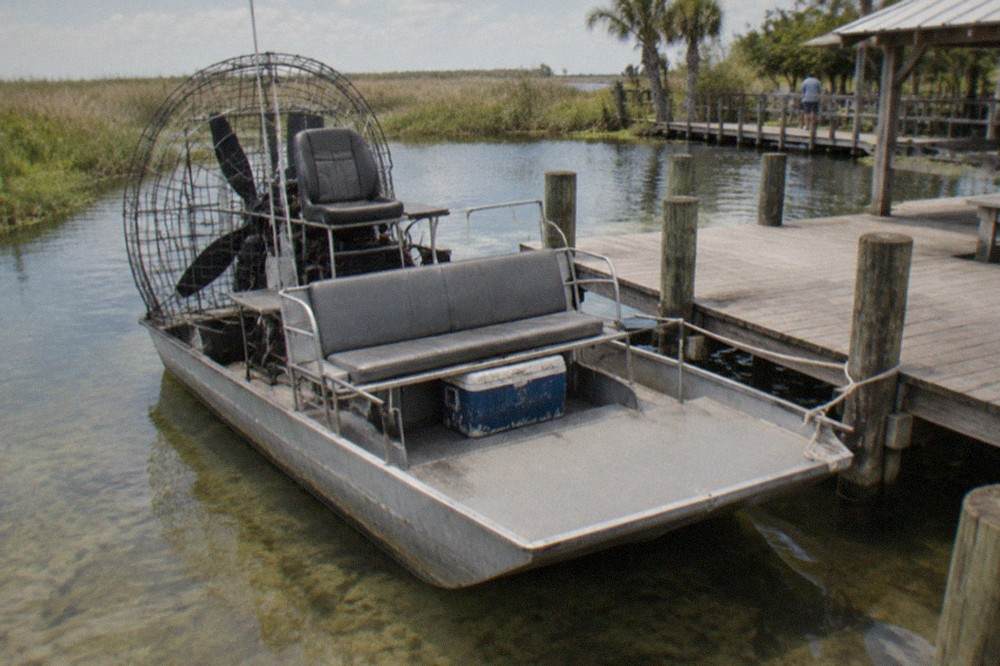
Then there is what is missing. A conventional boat hangs a propeller and gear case below the hull, a mass of hardware that can strike a submerged stump and violently stop or slew the boat. An airboat has none of that below the waterline. The engine and propeller sit on the stern above the deck, pushing air, so the boat can slide across vegetation, mud and inches of water without anything underwater to catch. On tours like the Florida Everglades wildlife airboat tour from Orlando, rated 4.7 from 352 reviews, the whole point is reaching exactly this kind of shallow habitat where alligators and wading birds congregate.
That is not the same as saying the boat cannot be capsized. It can, and the known mechanisms are specific. Hitting a fixed object, a dock, a canal bank or a submerged tree in deeper water than the operator expected, is the classic trigger. Turning too hard at speed with a poorly distributed load can also put a chine, the edge of the hull, into the water and roll the boat. Overloading shifts the freeboard down and makes every one of these failure modes more likely. The operators matter more than the machine: a captain who runs the same lake every day knows where the deep holes, stumps and shallow bars are, and commercial tour boats in the United States are subject to U.S. Coast Guard inspection.
| Design factor | How it affects stability |
|---|---|
| Wide, flat hull with a broad beam | Wide base resists rolling in normal turns |
| Low passenger seating | Keeps the loaded center of gravity low |
| Engine and propeller mounted above the stern | No underwater drive unit to snag on stumps or mud |
| Purpose-built for inches-deep water | Operators choose routes the boat is designed for |
| Turning technique by the captain | Hard over turns at speed are the main roll risk, avoided by trained drivers |
Florida's Airboat Law: Mufflers And Orange Flags
Florida law imposes two specific equipment requirements on every airboat on state waters: an automotive-style factory muffler or equivalent device on the exhaust, with cutouts or flex pipe alone prohibited, and a mast or flagpole at least 10 feet above the boat's lowest point flying an international-orange flag at least 10 by 12 inches, visible from every direction. Both violations are noncriminal infractions under Florida Statute 327.391.
The statute is unusually concrete, which makes it easy to check on your own tour. The muffler rule exists because an unmuffled airboat engine is extraordinarily loud, and the flag rule exists because a low, fast boat crossing open marsh is nearly invisible to other vessels. When you board a commercial ride, look at the stern and at the mast: if the boat flies the orange flag and the exhaust runs through a real muffler, you are looking at a legal, inspected operation. The full text lives on the Florida Senate's official site under Statute 327.391, Airboats regulated, and the state's plain-language summary is on the Florida Fish and Wildlife Conservation Commission boating regulations page.
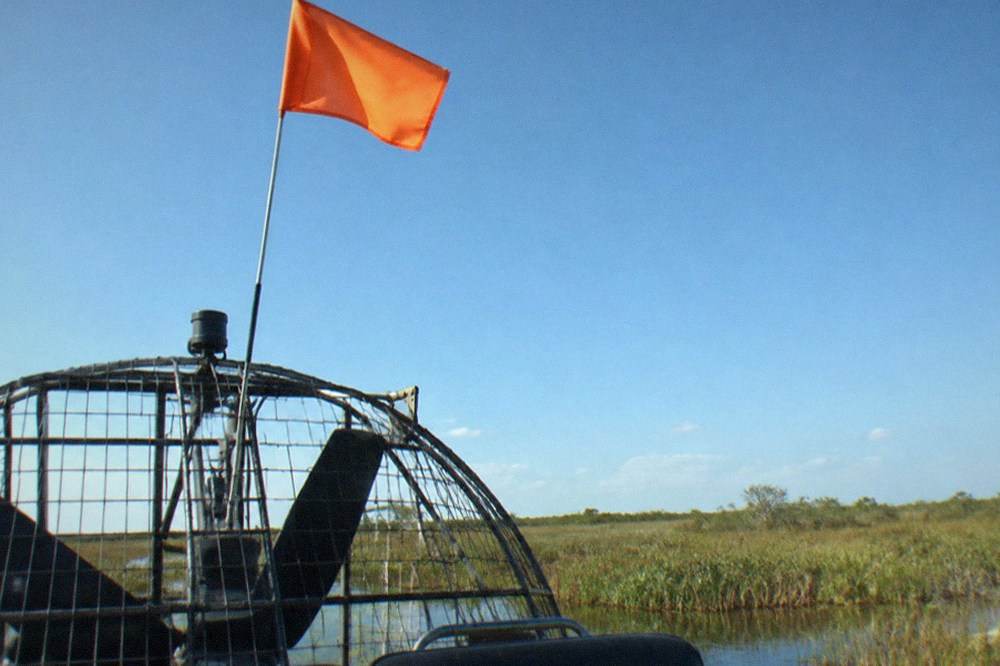
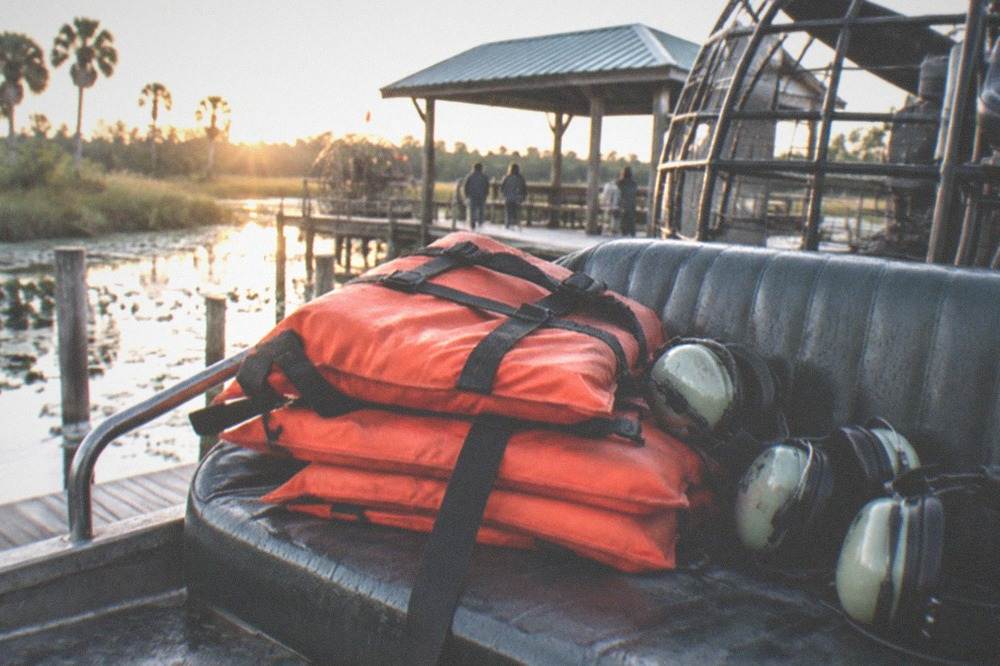
One distinction matters a great deal for honesty. The muffler and the flag are the law. Hearing protection and life jackets for adults are not: no Florida statute requires adult passengers to wear either, and this site will not present operator policy as if it were law. What actually happens on commercial rides is that operators supply ear protection and child life vests as their own practice, and the listings on this roster state those inclusions explicitly. The Orlando Airboat Tours roster records them per tour, exactly because the practice is the operator's, not the state's.
| Requirement | What the law says | Where to check on your ride |
|---|---|---|
| Exhaust muffler | Automotive-style factory muffler or equivalent; cutouts or flex pipe alone illegal | Visible muffler on the exhaust line behind the engine |
| Mast and flag | Mast or flagpole at least 10 ft above the vessel's lowest point | Tall pole at the stern or amidships |
| Flag specification | Square or rectangular, at least 10 x 12 inches, international orange, visible from all directions | Look for the orange flag before boarding |
| Enforcement | Noncriminal infraction under s. 327.73(1) | N/A, but commercial boats are also USCG-inspected |
Florida's Real Airboat Incident Record, 2025-2026
Three airboat incidents made Florida news between January and June 2026: a two-boat collision on the Peace River in DeSoto County that injured seven people, a capsizing on the Istokpoga Canal in Highlands County with three fatalities, and an ejection on the Little Manatee River after a boat hit shallow water. None of the three involved any operator on this roster, and serious unprovoked incidents remain rare across an industry that carries millions of riders.
Stating these plainly is more useful than either hiding them or amplifying them. The Peace River collision occurred on January 6, 2026, between two commercial airboats, with seven people injured and a Coast Guard investigation opened. The Istokpoga Canal capsizing on June 15, 2026, in the Kissimmee River area of Highlands County killed three people and was led by FWC investigators. On June 27, 2026, a rider was ejected on the Little Manatee River after the boat struck shallow water. Each is a real, sourced event, and each happened on remote southern or southwestern waters, hours from the Kissimmee chain of lakes where Orlando-area tours actually run.
The proportionate framing comes from the statewide numbers, not from any tour company's marketing. FWC's 2025 boating accident summary counted 694 reportable accidents and 51 fatalities across all vessel types in Florida, a state with more registered boats than any other. Airboats are a small fraction of that total. The FWC alligator program and harvest data, published at myfwc.com's alligator harvest pages, is a reminder of the same point from another direction: the wildlife is abundant, with roughly 16,184 alligators estimated in Lake Kissimmee and about 5,716 in Lake Tohopekaliga, and commercial tours coexist with those populations at a routine, unremarkable scale.
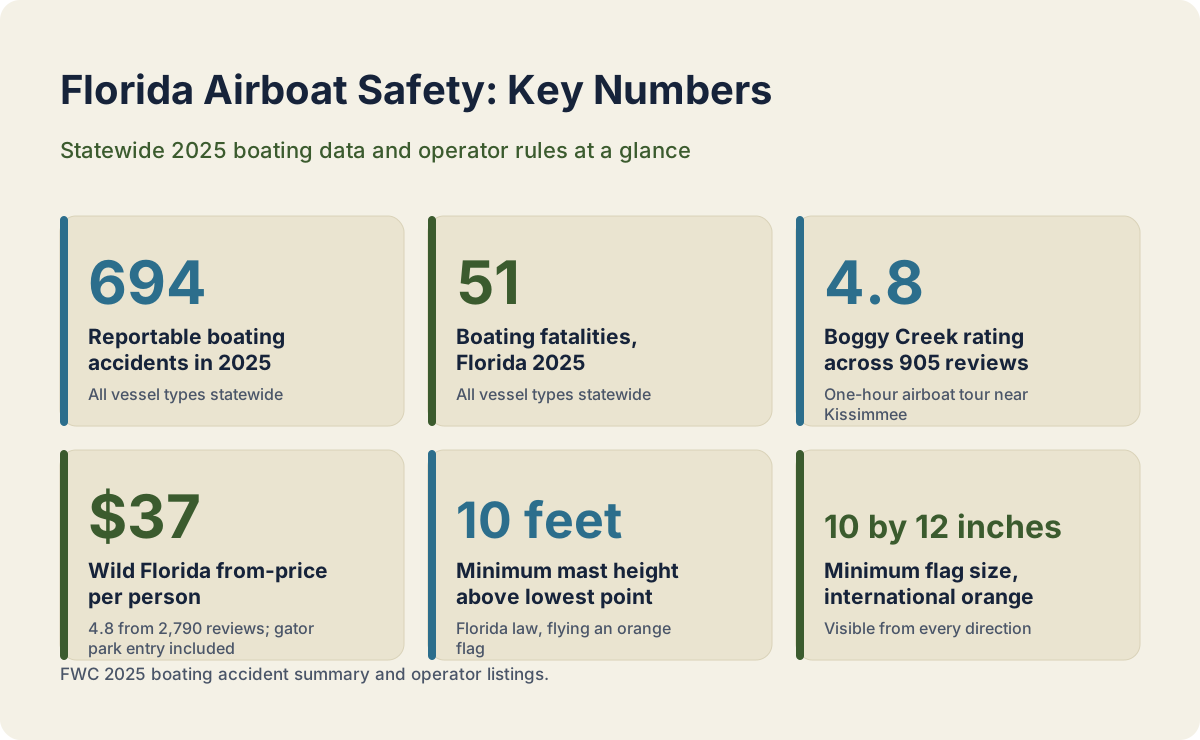
For context on how the region's biggest operators handle risk at volume, the Wild Florida airboat tour with park admission and optional lunch in Kenansville carries the deepest review pool on this roster, 4.8 from 2,790 reviews, at a from-price of $37 per person, and its listing includes gator park entry alongside the ride. High-volume, multi-year review pools of that size are one of the few honest proxies available for operational consistency, which is why this site prints review counts next to every rating rather than a bare score.
Kids, Life Jackets And Hearing Protection: Each Operator's Rules
Safety policies for children differ by operator and are the operator's own practice, not state law. Boggy Creek sets no minimum age and requires a provided Coast Guard-approved life jacket for children under 6; Wild Florida sets no age requirement and requires a life jacket for children five and under; both supply hearing protection for all passengers. No verified weight limit exists for any operator on this roster, and none should be quoted.
Because the real policies differ, this site prints them individually instead of averaging them into a fictional universal rule. Boggy Creek Airboat Adventures states no minimum age or height for its standard tours, with infants under 3 riding free, and it supplies hearing protection on board along with life jackets for young children. Wild Florida similarly has no age requirement, asks that infants be included in the reservation, provides ear protection for all guests and mandates life jackets for children five and under. Those are the two operators behind most of this roster's rides, including the family-friendly one-hour Boggy Creek airboat ride, which also includes park admission, the alligator viewing area and a butterfly garden in the ticket.
Pregnancy and mobility deserve the same careful wording. Boggy Creek documents no formal pregnancy restriction for its standard tour, though a separate drive-your-own-boat product advises against it for pregnant travelers. No operator on this roster publishes a verified weight limit. Wheelchairs cannot be loaded onto the airboats themselves, but ramps typically reach the dock, and boarding commonly involves a few physical steps with assistance from a guest's own party, a point covered in full in the accessibility discussion below. When a source does not state a policy, the honest answer is that it is not documented, and any site that invents a weight limit or a trimester cutoff is guessing.
| Operator | Child policy | Gear supplied | Documented pregnancy policy |
|---|---|---|---|
| Boggy Creek Airboat Adventures | No minimum age; life jacket required under 6; infants under 3 free | Hearing protection and Coast Guard-approved life jackets on board | None stated for standard tours; its drive-your-own product advises against it |
| Wild Florida (Kenansville) | No age requirement; life jacket required at 5 and under | Ear protection headphones for all; life jackets under seats | Nothing specific documented |
| Switchgrass Outfitters (Christmas, FL) | No strict minimum stated, families welcome; kids under 3 ride free on its private tours | Life vests and premium hearing headsets | Nothing specific documented |
Hearing protection deserves a special word because it is the one genuinely universal issue. Airboats are loud even when legally muffled, which is why the statute targets exhaust noise in the first place, and every operator above hands out ear protection before departure. Accept it. Families weighing the whole decision can go deeper with the airboat tours with kids in Orlando guide, which walks through age policies and what a first ride is actually like for small children.
Weather Cancellations: What Operators Actually Promise
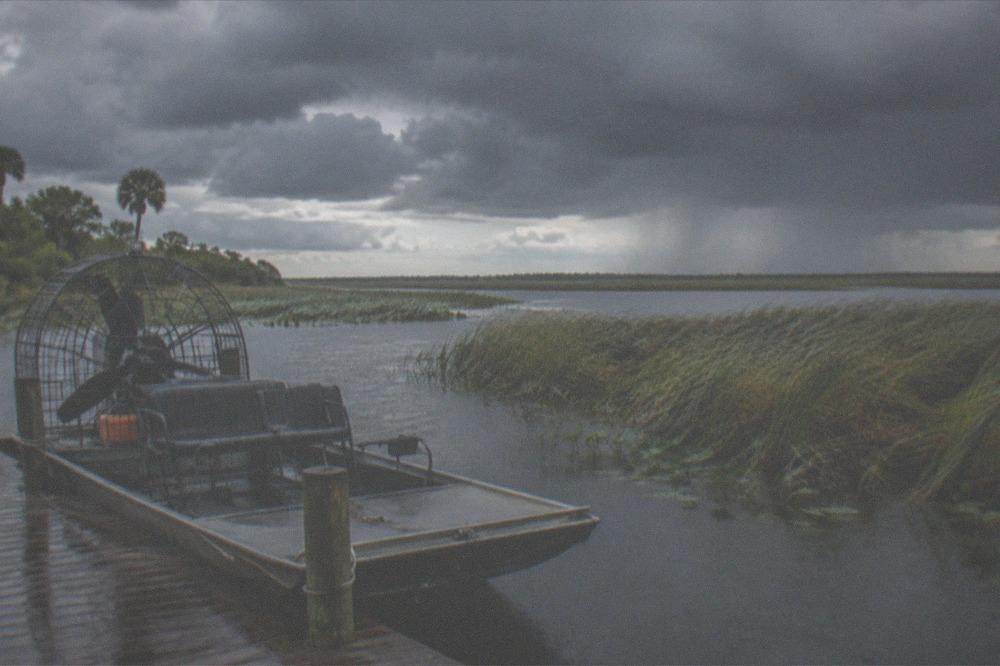
Boggy Creek states that any ride cancelled due to weather will be refunded or rescheduled based on the customer's availability, and Wild Florida allows a reschedule or full refund for severe-weather cancellations, with a standard 24-hour cancellation policy otherwise. Afternoon thunderstorms, not capsizing risk, are the single most common reason an Orlando airboat tour does not run as scheduled.
This is the risk that actually interferes with real trips. Central Florida's warm months bring routine afternoon thunderstorms, and an airboat cannot safely run in lightning or high wind regardless of how stable the hull is. Operators therefore hold rides rather than gamble, and the delay usually ends with the ride going out as soon as the cell passes. Arrive with a little schedule slack and the weather problem mostly solves itself.
The booking-side mechanics are simple. Reserve a slot, watch the forecast, and know the operator's stated policy before you are standing at the dock. The 1.5-hour Everglades wildlife airboat tour from Orlando is the kind of longer ride where a weather hold matters most, since a ninety-minute route leaves less room to squeeze the trip in before the next storm, and its listing carries the operator's cancellation terms. The seasonal side of this, including what hurricane season means for summer bookings, is covered separately in the hurricane season and airboat tours in Florida guide, and the timing question, mornings being calmer and cooler, is laid out in the best time of day for an airboat tour guide.
One habit worth adopting: book the first ride of the morning when your schedule allows. Operators themselves most often recommend the before-10am window, both for calmer air and because alligators bask more actively before the day heats up, which means the morning slots are the least likely to be weather-delayed and the most likely to deliver the wildlife the boat is there to find.
Accessibility And Boarding: The Honest Version
Ramps typically reach the dock at both Boggy Creek and Wild Florida, but boarding the airboat itself commonly requires a physical transfer across a few steps, and no operator on this roster guarantees full wheelchair accommodation onto the boat. Guests with mobility needs should call ahead, describe the situation, and expect a dock-level boarding process rather than a drive-on experience.
This site treats the subject plainly because the marketing copy rarely does. A wheelchair-friendly ramp to the dock is real and useful, and it is genuinely provided, Wild Florida describes its loading dock as ADA compliant with a wheelchair-friendly ramp to the airboat docks. The gap is the last few feet: airboats sit low and step-benched, and a wheelchair cannot be loaded aboard. Boggy Creek notes that assistance from the guest's own party may make boarding possible. For many riders this works fine; for some it does not, and knowing that in advance beats discovering it at the dock.
The practical advice is to contact the operator before booking rather than after, and to ask specifically about the boarding transfer, not just about ramps. Advance notice is what the operators themselves request for mobility needs. Booking the Wild Florida airboat and park combo with lunch option, whose ground attractions are reachable without a boat, can be a reasonable compromise for groups where one member would rather stay ashore, since the park side of that ticket does not require boarding anything.
Beyond mobility, the comfort factors that shape a safe-feeling ride are small and practical: secure loose hats and glasses, keep arms inside the boat, and stay seated for the whole run. If you are curious whether you will get wet, a fair question on any open boat, the do you get wet on an airboat ride guide answers it directly, and the best place to sit on an airboat guide covers which seats feel the most stable for nervous first-timers.
Common Questions About Airboat Safety
Can airboats tip over?
Yes, an airboat can capsize, typically after striking a fixed object, hitting unexpected shallow water at speed, or turning too hard with a badly balanced load. On commercial Orlando tours it is rare: the three airboat incidents that made Florida news in 2025-2026 all occurred on remote waters hours from this region, none involving any operator on this roster, and FWC's 2025 statewide data counted 694 reportable boating accidents across all vessel types.
Are airboats dangerous for tourists?
Commercial airboat tours run inspected boats with full-time captains on home waters they know intimately, and the volume of rides taken without incident each year is enormous by any measure. The realistic hazards for a tourist are sun, loud noise and an afternoon storm hold, all of which are managed with ear protection, sunscreen and the operators' weather-reschedule policies.
Does Florida law require life jackets or ear protection on airboats?
No. The two Florida requirements specific to airboats are an automotive-style factory muffler on the exhaust and a mast-mounted international-orange flag at least 10 by 12 inches flown at least 10 feet above the boat's lowest point. Hearing protection and children's life vests are supplied as each operator's own practice, with Boggy Creek requiring jackets under age 6 and Wild Florida at 5 and under.
Has anyone been hurt on an Orlando airboat tour?
The newsworthy 2025-2026 Florida airboat incidents, the Peace River collision that injured seven in January 2026 and the Istokpoga Canal capsizing with three fatalities in June 2026, happened on waters in DeSoto and Highlands counties, far outside the Orlando and Kissimmee tour corridor, and none involved an operator reviewed on this site. Serious incidents remain rare across the industry, per FWC's own framing.
What happens if my airboat tour is cancelled for weather?
Boggy Creek states a weather-cancelled ride is refunded or rescheduled based on your availability, and Wild Florida allows a reschedule or full refund for severe-weather cancellations, with a standard 24-hour cancellation policy otherwise. Most weather holds are delays rather than cancellations, since Central Florida storms typically pass within the hour.
Can children and pregnant riders take an airboat tour?
Children ride on every major operator here, with life jackets required under 6 at Boggy Creek and at 5 and under at Wild Florida, and infants under 3 riding free at Boggy Creek. For pregnancy, Boggy Creek documents no restriction on its standard tour, though its drive-your-own-boat product advises against it; Wild Florida publishes nothing specific, so ask the operator directly before booking.
Book Your Airboat Tour
Boggy Creek Airboat Adventures One-Hour Airboat Tour near Orlando, Florida
You've seen what actually makes an airboat stable, what Florida law requires, and the real 2025-2026 incident record. Check today's times on the one-hour Boggy Creek ride now, the reference tour this guide compares everything against.
Or compare:
- Orlando: Florida Everglades Wildlife Airboat Tour from $67 per person
- Florida Everglades Airboat Tour and Wild Florida Admission with Optional Lunch from $37 per person