How Much Do You Tip An Airboat Captain?
There is no published airboat-specific tipping standard, and that is exactly why the question gets asked so often. Here is how to think it through, with planning ranges tied to real tour prices.
Short answer
There is no official airboat tipping rate. General US guided-tour norms that travel publications commonly suggest run 10 to 20 percent of the ticket price, or roughly $5 to $10 per person for shorter rides. Tip for narration and safe boat handling rather than for alligator sightings, since no operator guarantees wildlife.
The commonly suggested tip on a $65.58 one-hour ride works out to about $6 to $13 per person. See today's price and times for that exact ride before you budget the tip.
Check Today's Price For The One-Hour Ride → Compare every tour
How Much Do You Tip An Airboat Captain?
There is no published, airboat-specific tipping standard, so the honest answer starts with general US tour-guide norms: travel publications commonly suggest 10 to 20 percent of the ticket price for guided tours, or roughly $5 to $10 per person on short rides. What you are actually paying for is the captain's narration, spotting skill, and boat handling, not the wildlife, because no operator guarantees an alligator sighting.
That last point matters more than any number. Every operator in this market states plainly that wildlife is wild and sightings cannot be guaranteed, so a tip tied to "how many gators did we see" is a tip built on a coin flip. A tip tied to whether the captain read the marsh, kept the ride safe, told you what you were looking at, and handled the boat well is a tip you can decide on with confidence before the boat even docks.
The question comes up constantly on the lakes northwest of Lake Tohopekaliga, where most Central Florida airboats actually depart. That launch corridor sits in the Kissimmee area, not downtown Orlando, and a one-hour ride there, such as the Boggy Creek one-hour airboat tour near Orlando, runs from $65.58 per person. At that price, the commonly suggested planning range works out to somewhere around $6 to $13 per passenger if you follow general tour-guiding norms, and plenty of families simply hand the captain a $20 bill for two riders and call it done.
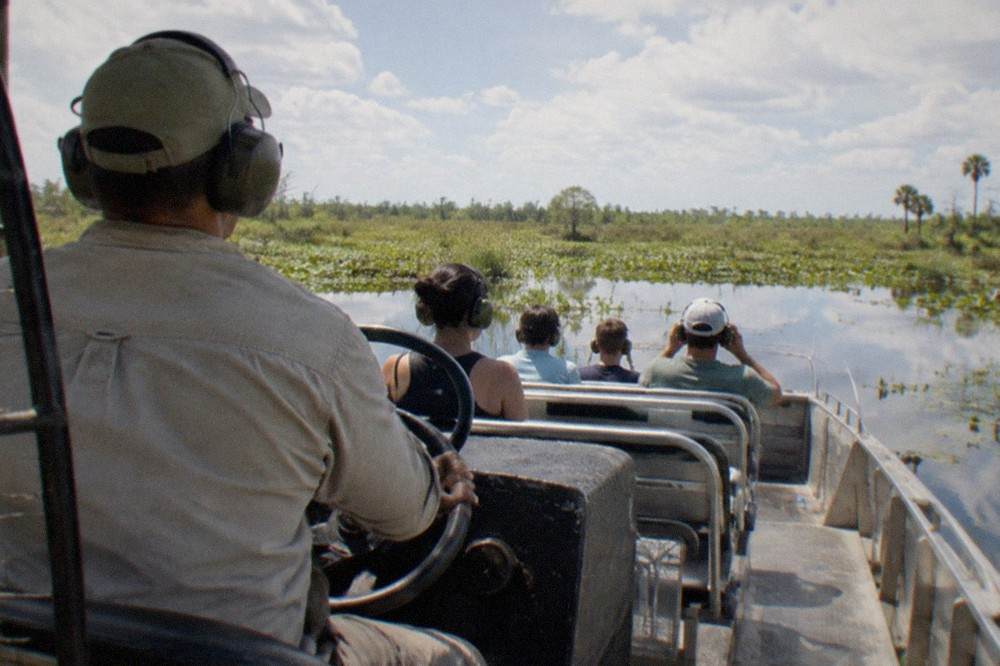
Before you fixate on the math, remember what the ticket already covers. On the Boggy Creek ride, park admission, an alligator viewing area, hearing protection, and life vests are included in the listed price, and the ride carries free cancellation. The tip is separate from all of that: it is your direct, tax-free-feeling thank-you to the person who actually drove the boat and found the wildlife, and it is the one part of the day where nobody prints a number on your receipt.
Is Tipping An Airboat Captain Expected In Florida?
Tipping is customary but not obligatory, and nobody on the dock will chase you for skipping it. US tour-industry practice treats captains and guides as tipped roles, the same category as tour guides and drivers, so most local riders tip something. If a ride genuinely delivered narration and safe handling, a tip is the norm rather than the exception.
The etiquette pressure is real but soft. You will sometimes see a tip jar or a bucket near the dock, and some captains mention it lightly at the end of a ride. Neither is a demand. The US travel industry broadly sorts service roles into tipped and untipped categories, and a captain who narrates, spots wildlife, and answers questions falls squarely into the tipped one, which is why the question "how much" exists rather than "whether."
For context on scale, Central Florida drew a record 76.7 million visitors in 2025, and Osceola County alone, where most of these launches sit, generated roughly $7.3 billion in direct visitor spending. Airboat crews are one small slice of the roughly 40,000 to 41,000 tourism jobs that spending supports in that county. Wages in guided-tour work across the US tend to be modest, and tips are understood by both sides as part of the compensation picture.
Practically, this means you should arrive with cash. On a short, budget-oriented ride like the 30-minute Orlando airboat tour with alligator and wildlife viewing, which starts from $44 per person, even a few dollars per rider lands as a normal, appreciated gesture. Nobody expects a percentage calculation to two decimal places on the dock.
The one thing to avoid is tipping out of pure awkwardness. If the captain was silent, rushed the route, or made the ride feel like a conveyor belt, the customary norm does not force your hand. Etiquette cuts both ways: a tip rewards good guiding, and its absence is one of the few quiet signals a rider can send.
What Should You Tip On Different Tour Prices And Lengths?
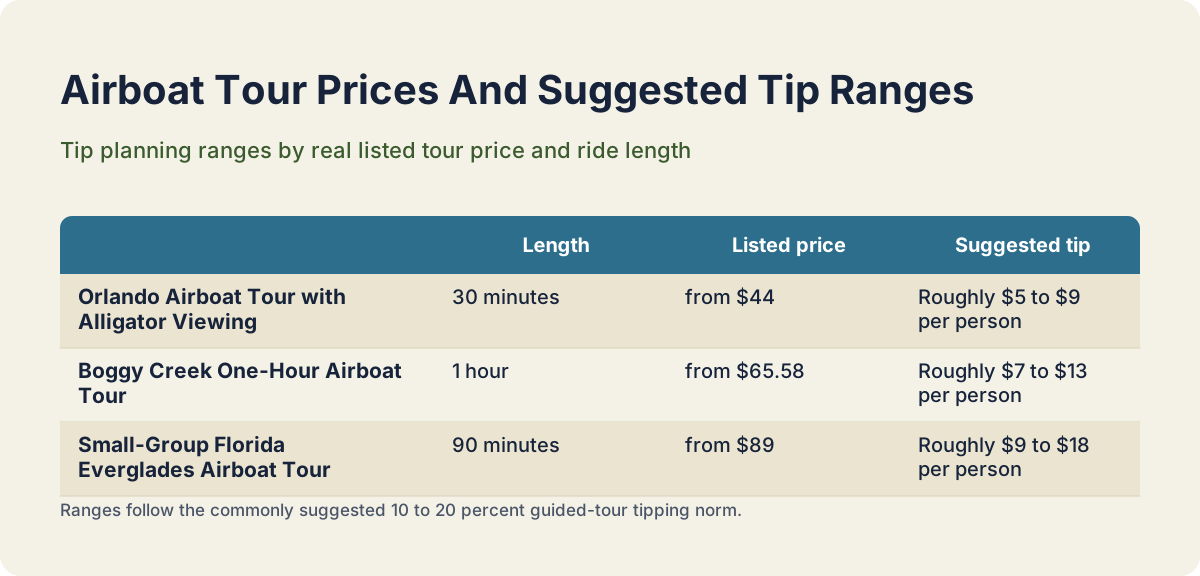
Work from the ticket price you actually paid, using the commonly suggested 10 to 20 percent planning range for guided tours, or a floor of a few dollars per person on short rides. A $44 half-hour ride suggests roughly $5 to $9 per person; a $65 to $89 one-hour or 90-minute ride suggests roughly $7 to $18 per person, depending on how good the guiding was.
The roster's real prices make the ranges concrete. The cheapest daytime option starts from $44 per person for 30 minutes, the one-hour Boggy Creek ride starts from $65.58, and the 90-minute small-group format starts from $89 per person. Longer rides cost more, take more skill to narrate, and run through more of the marsh, so the planning range scales naturally.
| Tour (real listed price) | Length | Commonly suggested tip planning range |
|---|---|---|
| Orlando Airboat Tour with Alligator and Wildlife Viewing, from $44 | 30 minutes | Roughly $5 to $9 per person |
| Boggy Creek One-Hour Airboat Tour, from $65.58 | 1 hour | Roughly $7 to $13 per person |
| Small-Group Florida Everglades Airboat Tour, from $89 | 90 minutes | Roughly $9 to $18 per person |
Notice what the table is not doing. It is not quoting an operator's official tipping policy, because no operator on this roster publishes one, and it is not inventing an airboat-specific percentage, because none exists in any verifiable source. It is translating general guided-tour norms, the kind you will find repeated across mainstream US travel advice, onto real ticket prices so you can budget before the day, not argue about it afterward.
If you are riding as a family of four, do the arithmetic once and bring it in bills. A $20 for a half-hour family ride and a $40 for a one-hour family ride both sit comfortably inside these ranges and are far easier to hand over than fumbling change while toddlers disembark.
The chart below compresses the same logic into one view: as ticket price and ride length climb, the commonly suggested band climbs with them, and the low end of each band assumes decent-but-unremarkable guiding while the high end assumes narration and spotting that genuinely made the ride.
When Is A Tip Clearly Earned?
A tip is clearly earned when the captain narrates continuously and well, spots wildlife you would have missed, manages the boat and the passengers safely, and adapts the route to conditions. Those are the deliverables you can actually judge from your seat. An alligator count is not one of them, because sightings depend on season, weather, and water, never on effort alone.
Think of the tip as payment for guiding, not for luck. The seasonal pattern on these lakes is well documented in operator guidance: in cooler, drier months, roughly November through April, alligators haul out onto banks more often to warm themselves, so sightings are generally more reliable, while in the wet heat of July through September they spend more time submerged or shaded. A captain cannot change any of that. What the captain can change is whether you understood what you saw.
Narration is the most tip-worthy thing on the water. On the small-group 90-minute Florida Everglades airboat tour, the format itself leans on the captain as a guide: fewer passengers, a longer route, and more room for questions about bird species, water levels, and gator behavior. That ride carries 4.8 across 1,372 reviews, the deepest review pool of any daytime tour in this market, and the recurring theme in guest reviews is the guide's knowledge, which is precisely the thing a tip rewards.
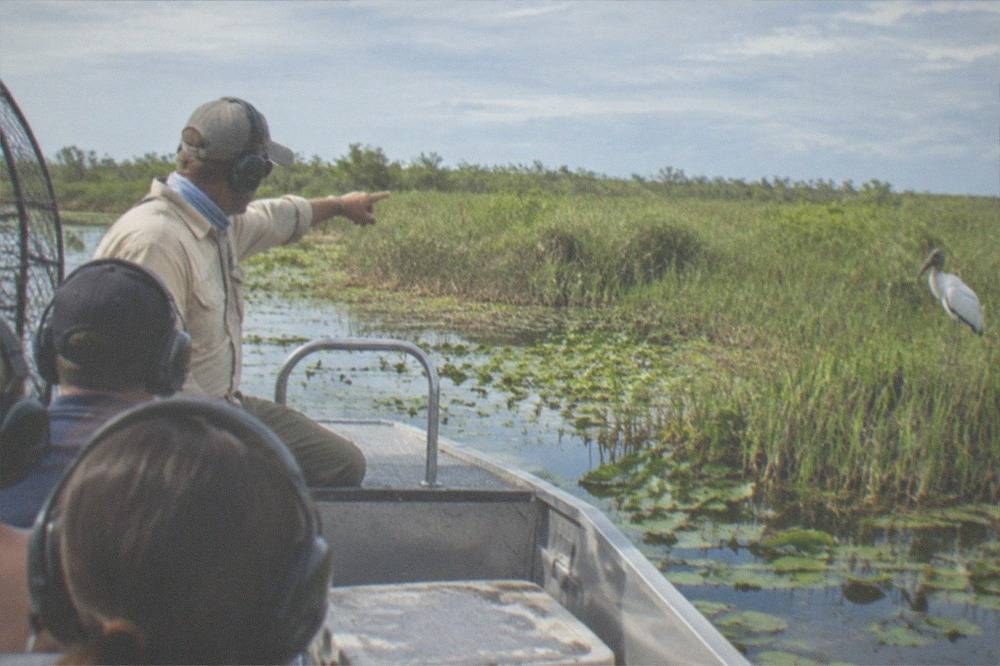
Safety handling earns the tip quietly. Florida law requires every airboat to run an automotive-style factory muffler and to fly a mast-mounted international-orange flag, at least 10 inches by 12 inches, at least 10 feet above the boat's lowest point, visible from every direction, under Fla. Stat. 327.391. You will see that orange flag on every compliant boat, including the ones on this roster. A captain who follows those rules, throttles down near docks and wildlife, and briefs passengers on ear protection and life vests for young children is doing the unglamorous half of the job, and doing it well.
Bird spotting counts too. The lakes and marshes around the launches are reliably good for bald eagles, sandhill cranes, great blue herons, snowy egrets, wood storks, osprey, snail kites, and roseate spoonbills, and a captain who knows where the rookeries are delivers a very different ride from one who merely drives a loop.
How Do Group Size And Tour Format Change The Tip?
On a shared public boat, tip per person as part of the crowd, since many riders contribute small amounts. On a small-group or private-style ride, your contribution carries more weight, so lean toward the upper end of the planning range. The format changes how visible your tip is, not whether one is customary.
The math of shared rides is worth spelling out. If a boat carries a dozen strangers and each adult hands over a few dollars, the captain's afternoon adds up fine, and no single rider carries the load. That is why low per-person amounts are perfectly respectable on the big shared boats. The Boggy Creek one-hour airboat ride runs as a shared-departure experience with park admission included, and the tip calculus there is the crowd model: a few dollars per rider, pooled.
Small-group flips that. When a boat carries only a handful of passengers, the same absolute tip comes from far fewer wallets, so riders commonly lean towards the top of the range to keep the captain's morning worthwhile. The 90-minute small-group Everglades format is the clearest case on this roster: its 4.8 rating across 1,372 reviews reflects exactly the kind of guided experience where a higher per-person tip is the recognized norm.
| Format | Who else is tipping | How to lean |
|---|---|---|
| Shared public boat, 30 to 60 minutes | A dozen or more riders per departure | Lower-to-mid range per person, a few dollars each |
| Small-group ride, 90 minutes | Only a handful of riders | Upper half of the range, more weight per person |
| Budget half-hour wildlife ride | Varies by departure | Mid range; keep it simple with bills |
There is a practical wrinkle here for families. On a shared boat, tip for the people who actually rode, children included, but at whatever reduced amount feels right; there is no rule, and nobody audits a family's envelope. On a small-group ride, one person usually collects and hands over the tip for the whole boat, which keeps the dock farewell short.
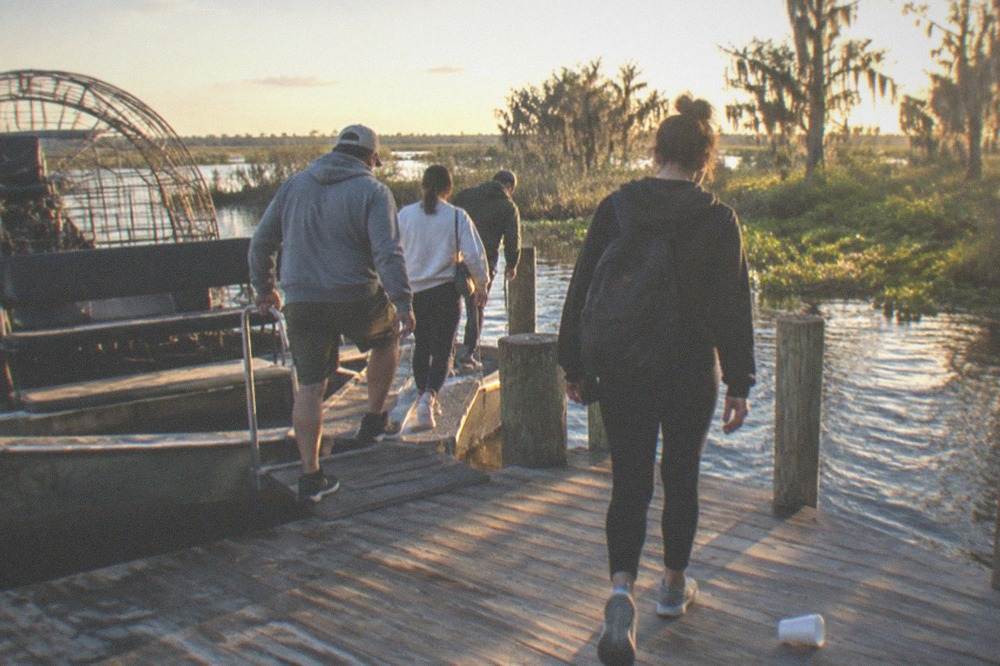
Are You Tipping The Captain, The Guide, Or The Company?
You are tipping the captain-guide directly, as an individual, not the operator. Airboat tickets are sold by operators and resellers, and the listed price covers the boat, fuel, park admission where included, and insurance. The cash you hand the captain is understood to stay with that person, which is the entire point of tipping in US tour practice.
This distinction explains why tips feel separate from the transaction even though you paid online for the ticket. When you book something like the 30-minute Orlando airboat tour with wildlife viewing through the operator's live listing, the platform fee, the operator's cut, and the captain's wage are all settled upstream of your ride. The tip is the only money on the dock that flows straight to the person who drove you.
That is also why nobody can print an official tip policy with a number on it. The operator sets prices, schedules, and safety practices, and supplies hearing protection and life vests as its own stated inclusions, but the tip economy between rider and captain sits outside all of that. Boggy Creek, for example, supplies hearing protection, life vests, park admission, and an alligator viewing area on its one-hour listing, and none of those inclusions touch what you separately hand the captain.
If a dock hand, ticket-taker, or parking attendant helps you specifically, a small separate thank-you is a nice gesture, but it is never expected and should never crowd out the captain's tip. Priority order if your cash is limited: captain first, everyone else second.
Cash, Card, And The Practical Side Of Handing Over A Tip?
Bring small bills in cash, hand the tip to the captain directly at the end of the ride, and skip the math theatrics at the dock. Cash is still the default on Florida airboats because not every dock has a card reader, and a direct hand-to-hand tip is the cleanest etiquette in US guiding.
The practical routine looks like this. Decide your amount during the ride, based on the narration and handling you are actually getting. Separate the bills from your wallet before the boat docks, so you are not digging through pockets while a line waits to board. Hand it over with a thank-you as you step off, or drop it in the dock bucket if one is out and the captain is busy with the next departure. That is the whole ritual.
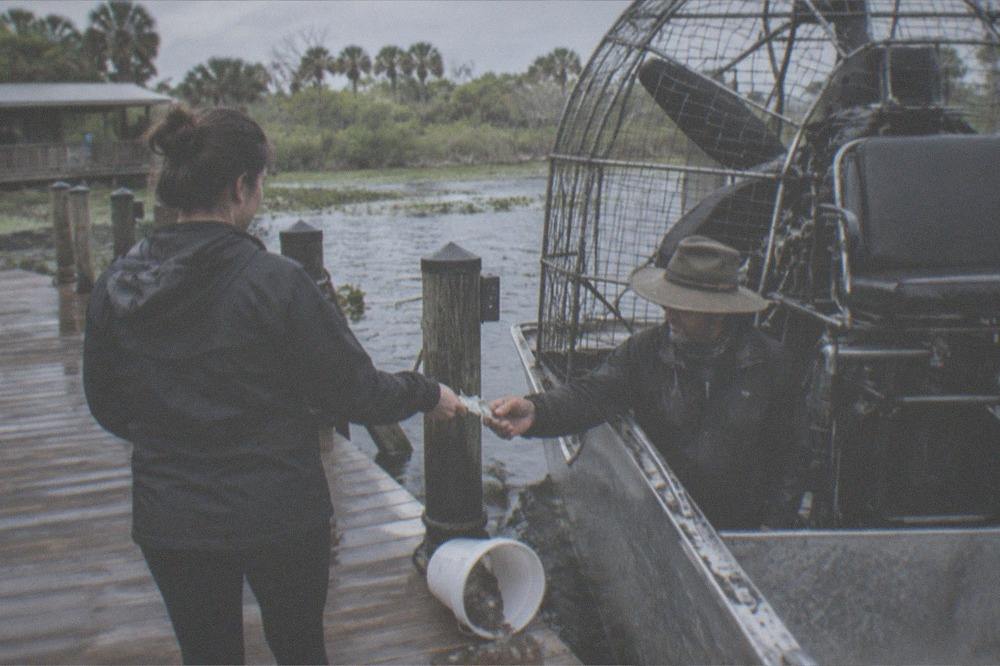
Timing-wise, end-of-ride is standard, and it lets you judge the full experience. Tipping at the start, occasionally seen on private charters to lock in extra effort, is unusual on public airboat rides and can read as awkward. End of ride, cash in hand, done.
A few riders ask about apps and QR codes. Some operators and captains do display them, but nothing on this roster's listings makes digital tipping the norm, and a captain mid-turnaround between departures will always prefer a bill. If all you have is a card and there is no reader, an honest "thank you, I only have a card" is fine; nobody is going to stand in judgment.
One planning note that protects the tip budget: book the ride you actually want before the day, and let the cancellation terms do the risk management. Boggy Creek's weather-cancelled rides are refunded or rescheduled based on the customer's availability, so a storm never eats the ticket money you were planning to split between the fare and the tip. Keep the tip cash in a separate pocket from spending money so it survives the gift shop, and if you are packing for the day itself, the guide on what to wear on an airboat ride covers the pockets-and-bills wardrobe question better than any tip advice can.
What If The Ride Disappoints: No Gators, Bad Weather, Silence?
If the guiding was good and the wildlife stayed hidden, tip anyway: the captain worked the marsh and the odds, and no operator anywhere guarantees a sighting. If the ride was genuinely poor, silent, rushed, or badly handled, a reduced tip or none at all is a legitimate etiquette choice. Judge the effort and the narration, not the alligator count.
The "no gators" scenario is the most common tip dilemma, and the seasonal facts settle it. In cooler, drier months, roughly November through April, alligators bask on banks more reliably, while in the wet season, especially the July-to-September nesting window, they spend more time submerged or shaded. A summer ride that sees three distant wakes had a captain working against the calendar, not against laziness. FWC's own statewide estimate is roughly 1.3 million alligators, and Lake Tohopekaliga carries an estimated 5,716 of them, so the animals are out there, but visibility is seasonal. A well-narrated ride such as the 90-minute small-group Everglades airboat tour can deliver a full hour and a half of guiding worth rewarding even on a quiet wildlife day, which is exactly the situation where judging the tip by sightings would misfire.
Weather is the other scenario, and operators spell out their own policies. Boggy Creek states that any ride cancelled due to weather will be refunded or rescheduled based on the customer's availability, and Wild Florida allows a reschedule or full refund for severe-weather cancellation with a standard 24-hour cancellation policy otherwise. A ride that goes out in gray, breezy conditions but still gets narrated well deserves the tip; a ride that gets cut short is a judgment call, and riders commonly reduce proportionally.
The one case where skipping the tip is genuinely defensible is a ride that failed on the service itself: a captain who never spoke, never pointed anything out, or handled the boat carelessly. That is not bad luck, it is the deliverable not being delivered. If you want a deeper look at the safety side of airboats, the guide on whether airboats can tip over covers the safety questions riders actually ask before deciding.
Tipping Mistakes To Avoid At The Dock?
The recurring mistakes are tipping nothing out of confusion rather than dissatisfaction, tipping on the alligator count instead of the guiding, arriving with no cash, and loudly renegotiating the amount in front of the captain. Decide during the ride, carry small bills, hand it over quietly, and let the planning range do the arguing for you.
Most awkwardness at the dock comes from not having decided beforehand. Riders who never thought about a tip stand there computing percentages against a $65.58 fare while the captain waits, and the result is either an over-tip from embarrassment or a skip from panic. Both are avoidable with the table earlier in this guide.
| Do | Avoid |
|---|---|
| Bring small bills, roughly $5 to $18 per person by ticket price | Arriving with only a card and no fallback |
| Judge narration, spotting, and safe handling | Judging the tip by how many alligators appeared |
| Hand the tip directly at the end of the ride | Tossing money mid-ride as if buying attention |
| Tip the captain, not the company | Assuming the ticket price already includes a gratuity |
| Reduce or skip only for genuinely poor service | Skipping because nobody told you the norm |
The alligator-count mistake deserves one last flag, because it punishes exactly the wrong variable. The lakes these tours run carry thousands of alligators between them, but their visibility swings with season, water level, and temperature, none of which the captain controls. The narration, the route knowledge, and the safe throttle work are the controllables, and they are what the tip is for.
Confusion about the norm is the other fixable mistake. US tour etiquette files the airboat captain under the general guided-tour umbrella, where 10 to 20 percent or a few dollars per person is the commonly suggested planning range, and the details of that framework are laid out plainly in the opening section here. There is no secret local Orlando rate, no operator-mandated amount, and no etiquette breach in asking the ticket booth a simple question about how tips are handled if you are unsure. Orlando Airboat Tours keeps the local answers in one place so you can settle the question before you ever reach the dock.
Common Questions About Tipping An Airboat Captain
How much do you tip an airboat captain?
There is no official rate. General US guided-tour norms commonly suggest 10 to 20 percent of the ticket price, which works out to roughly $5 to $9 per person on a $44 half-hour ride and roughly $7 to $18 per person on the $65 to $89 one-hour and 90-minute rides on this roster. Judge the narration and boat handling, not the alligator count.
Do you tip airboat captains in cash?
Yes, cash in small bills is the practical default. Not every dock has a card reader, a captain turning the boat around between departures prefers a bill, and a direct hand-to-hand tip at the end of the ride is the cleanest etiquette. Some captains display a QR code, but cash is the reliable option.
Should you tip if you did not see any alligators?
Generally yes, if the captain narrated well and worked the marsh. Alligator visibility is seasonal and weather-dependent, with cooler, drier months more reliable for basking sightings, and no operator guarantees a sighting. The tip rewards the guiding and safe boat handling, which the captain controls.
Do kids count toward the tip?
There is no rule. Families commonly tip per rider, sometimes at a reduced amount for children, and nobody audits the envelope. The simplest approach is to decide the total before the ride ends and hand it over in bills.
When should you not tip an airboat captain?
If the ride genuinely failed on service, a captain who never narrated, rushed the route, or handled the boat carelessly, a reduced tip or none at all is a legitimate choice. Bad luck with wildlife or gray weather is not a reason to skip; a missing deliverable is.
Is the tip included in the airboat ticket price?
No. The listed price covers the boat, fuel, and inclusions like park admission, hearing protection, and life vests where stated. The tip is separate cash that goes directly to the captain-guide, which is the whole point of it in US tour practice.
Book Your Airboat Tour
Boggy Creek Airboat Adventures One-Hour Airboat Tour near Orlando, Florida
You've seen the real planning ranges and what actually earns a tip. Check today's price and times for the one-hour Boggy Creek ride now, before you plan the rest of your day around a departure that might already be booked.
Estimate your total (uses Boggy Creek Airboat Adventures One-Hour Airboat Tour near Orlando, Florida's listed from-price of $65.58 per person)
Estimated total: $0 (verify the exact total, including any child price, on the live listing before booking)
Or compare:
- Small-Group Florida Everglades Airboat Tour (90 minutes) from $89 per person
- Orlando Airboat Tour with Alligator & Wildlife Viewing from $44 per person